
The 2026 Nissan Frontier stays true to midsize truck formulas: a V6 engine, body-on-frame construction, towing options and trim choices. While the competitors like Toyota Tacoma, Chevy Colorado and Ford Ranger are moving towards turbocharged engines and complex drivetrains, Frontier keeps it simple, predictable, mechanical and familiar.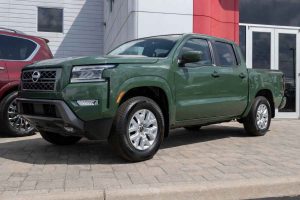
Below we will talk about Frontier 2026’s specs, real-world performance, fuel economy, interior quality and reliability outlook. We will also discuss which Frontier 2026 model makes the most sense based on how you plan to use it.
2026 Nissan Frontier: What Has (and Hasn’t) Changed
The current generation of Frontiers was released in 2022, but the last complex updates took place in 2024-2035. For 2026, Nissan carries those updates forward with no major design or functionality changes.
What stays the same for 2026:
- Same 3.8-liter naturally aspirated V6.
- Identical 9-speed automatic transmission.
- Same ladder-frame chassis.
- Same trim structure (S, SV, PRO-X, PRO-4X and long-bed models).
What matters:
- The 12.3″ touchscreen is a common feature now.
- More standard safety and driver-assist features on all the models.
- Better towing rating than the early third-gen.
The Frontier changes slowly, which is good news to customers who like mechanical consistency rather than fast redesigns.
Nissan Frontier Engine: Powertrain Breakdown
Every 2026 Nissan Frontier uses the same powertrain regardless of trim, an approach that’s increasingly rare in the midsize truck segment. Instead of offering multiple engines or turbocharged options, Nissan relies on a single naturally aspirated V6 across the entire lineup, prioritizing consistency and mechanical simplicity.
No matter what trim level you choose, all 2026 Nissan Frontiers have the same powertrain. This is becoming less common in the midsize truck market. Nissan only has one tuned V6 engine in all of its cars. This is because they want to keep things simple and consistent.
At the heart of the Frontier is a 3.8-liter direct-injection V6, paired with a 9-speed automatic transmission. Key powertrain details include:
- Engine: 3.8-liter Direct Injection V6
- Horsepower: 310 hp @ 6,400 rpm
- Torque: 281 lb-ft @ 4,400 rpm
- Transmission: 9-speed automatic
- Drivetrain: 4×2 standard, 4×4 available (PRO-4X standard)
This makes the Nissan Frontier horsepower figure one of the highest in the midsize truck
class for a non-turbo engine.
In real-world driving, the Frontier delivers smooth, predictable acceleration rather than an aggressive low-end surge. Independent testing from Car and Driver and Edmunds places the Frontier’s 0-60 mph time in the mid-7-second range, typically between 7.3 and 7.8 seconds, depending on configuration.
According to Edmunds, acceleration isn’t class-leading, but the engine feels strong in daily use thanks to its mid-range torque and refined shift.
Drivers will notice the Frontier’s strengths most during passing maneuvers, highway merging and towing, where power delivery remains consistent and easy to control:
- Linear throttle response with no turbo lag
- Strong mid-range pull for towing and passing
- Smooth, well-timed gear changes under load
Towing, Payload and Capability
The Frontier remains a capable truck for work and recreation, even if it doesn’t top the segment.
- Maximum towing capacity: up to 7,150 lbs
- Payload ranges roughly from 1,200 to 1,600 lbs depending on configuration
- Fully boxed ladder frame
- Utili-track® bed channel system for flexible cargo tie-downs
According to Edmunds’ towing and hauling evaluation, the Frontier handles trailers confidently and feels stable under load. They also point out that competitors like the Chevy Colorado and GMC Canyon offer higher maximum towing figures for buyers who regularly move heavier loads.
Fuel Economy and Real-world MPG
Fuel efficiency remains average for a V6 midsize truck.
- 4×2 models: about 19 mpg city / 24 mpg highway
- 4×4 PRO-4X models: around 16 mpg city / 20 mpg highway
Edmunds’ real-world testing recorded just under 20 mpg combined in mixed driving, which aligns closely with EPA expectations. The Nissan Frontier doesn’t have the best fuel economy in its class, but it is steady and predictable, especially when compared to turbocharged options that can change a lot depending on how you drive.
Interior Design, Comfort and Space
Inside, the Frontier mixes durability with modern features. Materials are durable and functional rather than luxurious and the overall design prioritizes physical controls over touch-only interfaces.
Front-seat comfort is generally good, though Edmunds notes that seat cushioning can feel firm on longer drives. Rear-seat space remains one of the Frontier’s weaker points. Even in the crew cab, adult passengers may find legroom tight, making the back seat better suited for short trips or occasional use.
Storage, however, is a strong point. The cabin includes multiple small-item bins, a large center console and under-seat storage in the rear, though the optional Fender audio system does reduce some of that space.
Infotainment and Technology
Technology in the Frontier 2026 focuses on usability rather than flash.
- 8-inch touchscreen standard on S
- 12.3-inch touchscreen on SV, PRO-X and PRO-4X
- Wireless Apple CarPlay® and Android Auto™
- USB-A and USB-C ports
- Optional Wi-Fi hotspot and wireless charging
Edmunds praises the screen size and responsiveness but criticizes the menu layout, noting that competitors from Ford, Toyota and GM offer more intuitive interfaces and cleaner graphics. Physical knobs for volume and tuning remain, which some buyers still prefer.
Safety and Driving Assistance
All trims include Nissan Safety Shield® 360, covering core driver-assist features such as:
- Automatic emergency braking with pedestrian detection
- Blind-spot monitoring
- Rear cross-traffic alert
- Lane-departure warning
Adaptive cruise control is available, though Edmunds points out that the Frontier lacks more advanced lane-centering systems found in some rivals. Camera quality is functional but not class-leading.
Reliability and Ownership Outlook
The Nissan Frontier reliability story is largely built around simplicity. A single engine option, no turbocharging and a long-running platform reduce mechanical complexity.
Warranty coverage includes:
- 3 years / 36,000 miles basic
- 5 years / 60,000 miles powertrain
Edmunds rates the Frontier as average for value, noting solid build quality but pointing out that Nissan does not include complimentary maintenance, which some competitors offer.
Trim-Level Perspective
Rather than radically different personalities, Frontier trims mainly adjust equipment and capability.
- S is best for buyers focused on price and basic capability.
- SV offers the most balanced mix of features and value and is often recommended by both reviewers and dealers.
- PRO-X adds off-road styling and suspension but keeps rear-wheel drive.
- PRO-4X is the true off-road option, with four-wheel drive, a locking rear differential, skid plates and terrain modes.
Edmunds consistently highlights the SV as the smartest choice for most buyers, especially when paired with four-wheel drive.
Ride Quality and On-Road Behavior
The Frontier is often praised for its “heavy” and substantial feel, which provides a sense of durability but may feel dated to some.
- Refined suspension: Unlike the bouncy unibody trucks (like the Honda Ridgeline), the Frontier uses a traditional leaf-spring rear suspension. However, Nissan has tuned it to be surprisingly compliant, absorbing highway expansion joints and potholes without the “jitter” common in older pickups.
- Steering feel: The Frontier retains hydraulic-assist-style steering, which is notably heavier than the light, electric systems in the Chevy Colorado or Ford Ranger. This makes it feel stable at high speeds but requires more effort during tight parallel parking.
- Cabin quietness: Nissan has prioritized acoustic glass and sound-deadening materials, making the 2026 cabin one of the quietest in the midsize segment.
Powertrain: The $3.8L$ V6 delivers $310$ horsepower and $281$ lb-ft of torque. Because it isn’t turbocharged, power delivery is linear and predictable, though it lacks the low-end “grunt” found in the Colorado’s turbo-four.
Off-Road Capability
The 2026 model introduces more technical control for off-road enthusiasts.
- New Drive Mode Selector: Available on SV 4×4 and PRO-4X grades, this system optimizes throttle and traction for rock, sand, mud and on-road conditions.
- PRO-4X hardware: This trim remains the gold standard for Frontier off-roading, featuring Bilstein monotube shocks, an electronic locking rear differential and three underbody steel skid plates.
- Roush PRO-4X R package: New for 2026, this collaboration adds a 2-inch lift using Roush x Ohlins 2.0 suspension, 17-inch titanium wheels and beefier Hankook Dynapro AT2 tires.
Tech support: The “Intelligent Around View Monitor” includes an off-road mode that acts as a virtual spotter, showing exactly where your front tires are placed on narrow trails.
Ownership Costs and Maintenance Reality
The Frontier’s biggest selling point for long-term owners is its mechanical simplicity.
| Metric | Expectation |
| Fuel Economy | Approx. 18 city / 24 highway (2WD); 17/22 (4WD). This is lower than some hybrid rivals. |
| Maintenance Schedule | Oil changes and tire rotations are recommended every 5,000 miles. |
| Long-Term Reliability | The pickup has high long-term reliability. The $3.8L$ V6 is a “tried and true” design without the added heat and stress of turbochargers, which usually leads to lower repair costs after the 100k-mile mark. |
| Resale Value | Historically strong. Frontiers are highly sought after in the used market by people looking for “bulletproof” work trucks. |
Who Should (and Shouldn’t) Buy the 2026 Frontier
Buy the 2026 Frontier if:
- You keep your trucks for 10+ years: The naturally aspirated V6 is built for longevity.
- You want a “real truck” feel: If you enjoy heavy steering and a sense of “heft,” this is for you.
- Value is key: Nissan often prices the Frontier lower than equivalent Tacoma or Ranger trims while offering more standard features (like the 12.3-inch screen on SV and above).
Skip the 2026 Frontier if:
- You need maximum rear seat space: the Frontier’s rear legroom is tighter than the Chevy Colorado or Jeep Gladiator.
- Fuel efficiency is your priority: if you want 25-30 MPG, you’ll need to look at the Toyota Tacoma Hybrid.
- You want “high-tech” steering: if you prefer light, effortless steering for city driving, the Frontier’s heavy wheel will be a chore.
The 2026 Nissan Frontier review ultimately comes down to expectations. It does not aim to be the most advanced or the most efficient midsize truck. Instead, it offers a straightforward V6 powertrain, solid towing and payload capability and a traditional truck feel that some competitors have moved away from.
Edmunds sums it up well: the Frontier is comfortable, easy to live with and mechanically honest, even if it lacks standout features. For buyers who value consistency over cutting-edge tech, the Frontier 2026 remains a dependable and rational choice in a crowded segment.